
There’s a reason practitioners keep returning to the birth chart long after the novelty of astrology wears off, it works differently than horoscopes do. The natal chart isn’t a personality type or a generalized Sun sign reading; it’s a precision instrument built from accurate data tied to a specific moment and place. I remember the first time I studied a properly rendered chart wheel, the planets, Ascendant, Midheaven, and degree-level positions all mapped with clinical specificity, and understood why interpretation demands more than pattern recognition. The gap between surface-level star talk and what a birth chart calculator actually produces is enormous: one is entertainment, the other is a personalized diagnostic built on up-to-date planetary databases calibrated against NASA ephemeris data.
What makes this kind of tool genuinely useful isn’t just the volume of features it offers, multiple house systems, sidereal calculation, custom orb limits, aspects, house positions, declinations, but how that depth translates into real insight. When someone enters their birth data, birthdate, birth time, birth city, and runs a full report, they’re not receiving a nuanced free novelty. They’re accessing layered context that spans past, present, and future: everything from compatibility analysis via a Synastry Chart to astrological transits tracking a current situation against a personal natal chart. The convergence of relationship reports, forecasts, and previsions reports under one roof is what separates a serious chart service from the scattered options most people first encounter on the internet. This tool handles the full range, and then some.
What Does Your Birth Chart Include? (Planets, Signs, Houses, Aspects)
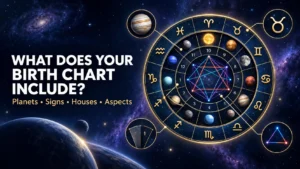
Most people assume a birth chart begins and ends with their sign, but the moment you examine the whole picture, it becomes something far more layered. A well-structured chart breaks down into parts that each carry distinct weight: the houses map out life’s key arenas, from the first house of identity to the tenth house of career and public standing. Each is traditionally labeled using Roman Numerals, and when a planet lands on a cusp, its energy can feel almost contradictory, pulled between two distinct forces at once. An interpretive report helps decode these tensions, translating raw technical details into something an individual can genuinely apply, through clean tables, visual breakdowns, and layered overlays that bring structure to what might otherwise feel like noise. Whether you’re examining business instincts or emotional patterns, the modern look of today’s chart tools makes this depth far more approachable than it once was.
What truly separates a rich birth chart reading from a surface-level one is how it maps chart patterns, geometric configurations that expose the deeper mechanics of a person’s life design. Among the 17 recognized formations, you might find a stellium clustering intense energy in one area, a t-square creating productive friction, a grand trine offering natural ease, a grand-cross demanding integration, a Yod pointing toward specific destiny themes, a Star of David combining harmonic triangles, a rectangle creating structured tension, or even a castle pattern that grounds otherwise scattered energies. These configurations reveal not just who someone is, but where they’ll encounter real challenges, how they can grow through them, and in what direction they’re meant to evolve. There’s a particular love that takes hold when you realize your chart isn’t simply a unique label, it’s a dynamic map that shifts in meaning as you do.
How to Use the Birth Chart Calculator
The conventional assumption, that a birth chart is just a snapshot of your Sun sign, dramatically undersells what this tool actually does. At its core, a natal chart is a unique, 360-degree chartwheel, a celestial wheel, that maps the interplay of archetypes and character across your soul’s personal evolution, with all planets, Sun, Moon, Mercury, Venus, Mars, each plotted at an exact degree against the 12 zodiac signs and constellations at your moment of birth. To calculate yours, open the form, enter your birthdate, exact birth time, and place, the program uses these three points to anchor each sign placement, houses, and house system position, leveraging planetary coordinates that automatically correct for daylight savings and location variations. The screen reveals, and this part consistently surprises first-time users, a fully personalized, easy-to-read, free birth chart with a modern look after you click the OK button; the tool generates this from raw birth data, resolving Sun sign, Moon sign, Mercury sign, Venus sign, and Mars sign alongside the Ascendant (rising sign) with crisp astrological clarity.
Once the chart loads, all the features of the settings area open a genuinely customizable experience, explore all sections, customize aspects, orbs, and declinations, activate asteroids, adjust ratings, toggle sidereal charts, and pull compatibility charts or a relationship report. Whether the Sun falls in Aries, Leo, or Gemini, every domain, transits, forecasts, horoscopes, and articles, draws from the same birth data to map astrological elements across your present, past, and future growth. Entering a second person’s date of birth and birth time overlays both Birth Charts to create a compatibility report, either a short compatibility report or a fuller compatibility report, applying interpretations to dynamics, planetary positions, and midpoint data with full natal depth. The transits section then anchors these positions to a 14 days or full year arc, tracing cyclical energy and power as they influence personal growth, making this chart service one of the broadest avenues for astrology insight, astrology reports, and individual listing analysis, a resource any practitioner can use to explore zodiac depth, compatibility, and personal evolution across two individuals with genuine precision.
Unknown Birth Time
Working without a confirmed birth hour isn’t the obstacle it appears, seasoned practitioners understand that a Time Unknown chart still carries substantial interpretive weight. When you calculate a chart under these conditions, the house system becomes temporarily bracketed, which paradoxically sharpens the focus onto sign placements, major aspects, and asteroids that hold their positions regardless of birth hour. A natal chart report constructed this way faithfully captures the planetary architecture of that day, the Sun, most outer planets, and nodal axis remain fixed. For location situations where hospital records were never issued or were lost, this honest limitation doesn’t invalidate the reading; it simply reframes what’s being examined.
The established convention is to set noon as the default birth time, positioning the chart at the precise temporal midpoint of the day, this yields the most statistically average lunar placement across a 24-hour arc. The Moon can shift up to 15 degrees within a single day, so a noon entry minimizes cumulative positional error better than any arbitrary guess. Sidereal charts and daylight savings corrections still apply cleanly to the birth location coordinates entered, and all non-angular chart factors interpret normally. The anonymous quality of a time-estimated chart should simply be flagged during interpretation, work around the ascendant and midheaven, and let the planetary pattern speak for what it can reliably confirm.
Data Privacy
When using a birth chart calculator, the input you provide — including your name field entries, birth times, birthplace location field, and other personal details — raises a natural question: where does this information actually go? Unlike platforms that require an email to proceed, many calculators are designed to function without collecting identifiable information. The data you enter, such as a nickname or person-specific detail, typically stays on your device rather than being transmitted elsewhere. This local-first design respects both your accuracy requirements and your right to privacy, ensuring that time-sensitive data tied to your chart is handled with real discretion rather than treated as a commodity.
The saving and database architecture of modern birth chart tools reflects a meaningful shift toward user-controlled privacy. When you save your chart data or build multiple reports, the information is often stored through a profile number system that carries no link back to a real-world identity. Users who value convenience can still access their stored charts through the settings area without surrendering sensitive details. Whether you’re generating reports for yourself or another person, the tool’s design prioritizes locations and input security, meaning your download of any chart or report should never come at the cost of your personal data being exposed or misused.
Relationship Reports
Relationship reports generated through a birth chart calculator go far beyond surface zodiac constellation comparisons, they depend on precise calculations that map how two people’s planetary placements interact geometrically across a composite or synastry overlay. Practitioners who regularly analyze charts know the most diagnostic chart patterns emerge between two people’s maps: a grand trine signals natural emotional flow, a t-square or grand-cross defines structural tension, and a stellium in one person’s chart landing on another’s key angles can shape the relational tone entirely. Rarer formations, the Yod, the Star of David, the rectangle, and the castle, carry fated or architectural relational meaning that generic scoring systems never surface. When a full analysis identifies 17 or more cross-aspects between two charts, the reading becomes extraordinarily specific, revealing exactly how the relationship functions beneath the day-to-day texture of shared life experience.
From the initial screen, entering both individuals’ birth data is direct, the astrology reports panel builds a list of selection options for overlay type, orbs, and display layout, with an arrow control and hide/show toggle to customize output even on a small screen. Pressing the OK button to create the synastry report takes only seconds. When a partner’s time is entered as unknown birth time or flagged as Time Unknown, the tool calculates across a range from 00:01 through 23:59 over 2-1/2 days, accounting for sign changes near any cusp, field entry variations, and common location situations, using an average method to help determine which placements remain stable. Users who sign in or log in through a browser via PIN or email address can retrieve saved charts and access their full birth chart list from a secure personal database, with profile details, profile number, chart data, stored data, and data stored on the server all preserved within the account entry panel. Options to delete individual records, manage cookie and cache preferences, or clear cache on a device or computer are available without touching server-side records, locally erased data does not alter what the account holds. The transits report adds a live interpretive layer, reflecting how today’s planetary positions interact with the synastry map and where both partners must adapt as significant planetary events, sometimes pinpointed to a noon position, continue to unfold across their shared life path.
Why Use This Calculator
Most people stumble into astrology through a Sun sign column, never realizing that full birth charts carry far more power than a single placement ever could. What separates a serious practitioner from a casual reader is access to accurate data, the kind pulled from planetary databases refined over decades and cross-referenced with NASA ephemeris records. A reliable chart service doesn’t just hand you a wheel and walk away; it accounts for daylight savings shifts, pinpoints your exact place of birth, and handles the kind of location situations that generic horoscopes simply gloss over. The birthdate you enter, down to the minute, determines whether a planet falls in one house or the next, and that single aspect changes everything.
What makes a calculator worth returning to is the depth hidden inside its settings area. The ability to customize, toggling between multiple house systems, enabling sidereal calculation, adjusting custom orb limits, or layering in asteroid bodies, transforms a basic lookup into something genuinely personalized. You can map transits across past, present, and future timelines, pull declinations for precision work, and build compatibility charts through calculations that go far beyond Sun-sign matching. User ratings consistently favor tools that stay up-to-date, carry a modern look, run cleanly over the internet, and remain free, placing serious astrological features and that birth chart energy within reach regardless of your year of experience.
Do I need to share my email to get a birth chart?
No, you don’t need to provide your email address to generate your birth chart. Simply enter your birth details, date, time, and place, and your chart is ready instantly. I built this with privacy in mind, so there’s no account creation or sign-up wall standing between you and your astrological data.
What if I don’t know my birth time?
Not knowing your exact birth time is more common than you’d think. You can still generate a meaningful natal chart using a solar chart or by defaulting to noon time, which gives you accurate planetary positions for most of the chart, the only real limitation is the rising sign and precise house placements, which depend on time.
Is the birth chart free to use?
Yes, the birth chart calculator is completely free to use. You get full access to your natal placements, planetary aspects, and house positions without any hidden fees. No trial periods, no paywalls, just a straightforward tool built to make astrology genuinely accessible to everyone.
Can I save my chart data?
Your chart data can be saved directly from the results page for easy reference later. I’d recommend screenshotting or downloading the chart wheel and placement summary if you want a permanent copy, since no user account is required to store data on the backend.
Can I create a compatibility report?
Yes using two individual birth charts, you can run a synastry report to explore relationship compatibility. It maps planetary aspects between two people, highlighting areas of natural harmony, tension, and karmic connection. It’s one of the most practical uses of comparative astrology for real relationships.
How is the birth chart calculated?
The birth chart is calculated using your date, time, and place of birth to determine where each planet was positioned in the zodiac at that exact moment. The tool uses Swiss Ephemeris data the same trusted astronomical database professional astrologers rely on to pinpoint celestial positions with precision.
What chart patterns can I find?
The chart highlights key aspect patterns like Grand Trines, T-Squares, Yods, Stelliums, and oppositions, formations that reveal dominant energetic themes in your natal chart. These patterns often point to your strongest personality traits, recurring life challenges, and areas of natural talent worth paying attention to.